Best For · Best for leather work
The best sewing machines for leather and faux leather
A household machine will sew faux leather and thin hide. It will not sew a belt. The honest version of this answer saves you a ruined machine.
By Michael W. · Published
Disclosure: this page contains affiliate links. As an Amazon Associate, StitchStarter earns from qualifying purchases at no extra cost to you. We do not display prices - they change daily, so every button opens the live listing. It never changes which machines we recommend. Full disclosure.
Quick picks
The short answer. Every pick is explained in full below, including who should skip it.
| # | Product | Best for | Score | Price |
|---|---|---|---|---|
| 1 |  Singer Heavy Duty 4452Metal frame, high foot lift, and the walking foot already in the box. Singer Heavy Duty 4452Metal frame, high foot lift, and the walking foot already in the box. | Best for faux and thin leather | 7.7 | |
| 2 |  Singer Heavy Duty 4423The identical machine. Buy the walking foot separately. Singer Heavy Duty 4423The identical machine. Buy the walking foot separately. | Best value for the same job | 7.8 | |
| 3 | Singer Heavy Duty 4432Same frame and lift, 32 stitches, no walking foot. | Best if you want the stitches too | 7.6 | |
| 4 |  Brother CS7000XPatches and trim, slowly - and far better at everything else. Brother CS7000XPatches and trim, slowly - and far better at everything else. | Best for occasional faux leather | 8.2 |
Scores are our editorial judgment on six axes, explained on the methodology page. We do not run a test lab and never claim to.
The best household sewing machine for leather is the Singer Heavy Duty 4452, and the honest sentence that has to come straight after it is this: it will sew faux leather, vinyl and thin garment leather, and it will not sew a belt, a saddle or upholstery hide. No domestic machine will. If your project is real structural leather, the machine you need is an industrial walking-foot or cylinder-arm machine, and this is not the page for it.
Within what a domestic machine can do, the 4452 is the pick because it combines the three things leather-like material demands: a metal interior frame that does not flex, a presser foot that lifts high enough to get stiff layers underneath, and an even-feed walking foot already in the accessory box. The Singer Heavy Duty 4423 is mechanically the same machine if you would rather buy the foot separately.
What people mean by “leather”
Almost every disappointed review of a sewing machine and leather comes down to this word covering four very different materials.
Faux leather and vinyl - the material in most bag patterns, laptop sleeves and craft kits. Thin, consistent, and well within a heavy-duty domestic machine with the right needle and foot.
Thin garment leather - lambskin, deerskin, the weight used for soft jackets and gloves. Sewable on a metal-framed domestic machine, carefully, with a leather needle.
Leather patches and trim - a logo patch on a cap, a reinforcing patch on a bag. Occasional and small, and most machines on this site will manage one.
Structural leather - bridle, veg-tan, upholstery hide, belt leather. This needs a machine with a compound feed and a motor built for it. A domestic machine attempting it does not fail gracefully: you bend needles, jam the feed and can strip the gears.
The four, side by side
Specifications as published by each manufacturer.
The three Singers in that table sew identically - the same chassis, the same stainless steel bedplate, the same 1,100 stitches per minute, the same extra-high foot lift. The only differences are the stitch library and whether the walking foot is in the box, which our 4452 against the 4432 takes apart properly.
Why leather is hard for a sewing machine
Not because it is tough. Because it does not behave like cloth in three specific ways.
It does not slide. Faux leather and vinyl grip the presser foot and drag against the needle plate, so the top layer stalls while the feed dogs pull the bottom layer through - which is exactly the problem a walking foot solves, and the reason it is the first accessory to buy.
It does not forgive. Every needle hole is permanent. You cannot unpick a seam and sew it again a millimetre over, so basting tape and clips replace pins, and a test piece stops being optional.
It is thick in a way that stacks. Two layers of vinyl plus a lining plus a folded edge is a sudden five-layer step, and a plastic-framed machine flexes rather than driving through it, which is where skipped stitches come from. Our skipped stitches guide covers the diagnosis.
The needle does half the work
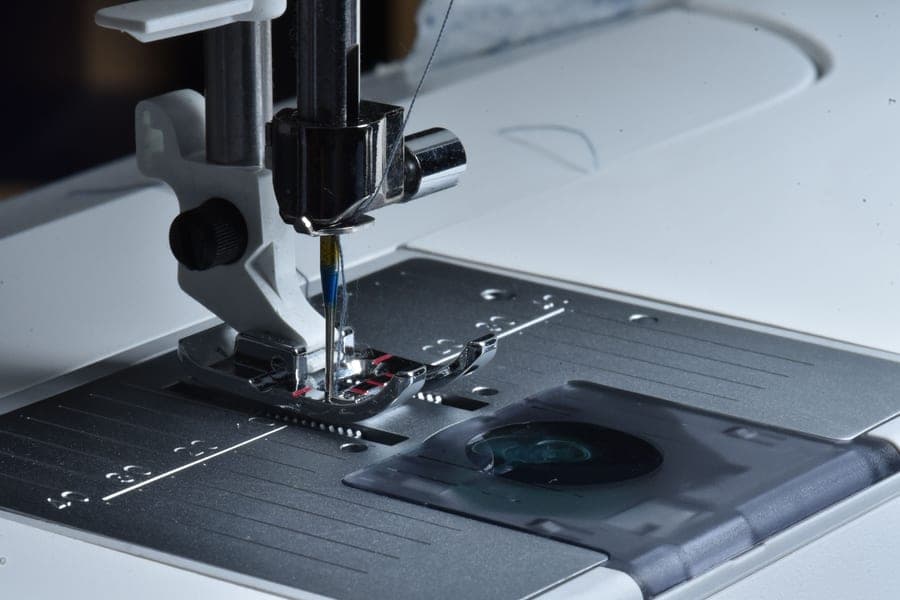
A leather needle has a chisel-shaped point that cuts a small slit instead of pushing fibres aside, and it is the single cheapest improvement available here. Size 14 to 16 for faux leather and thin hide; a universal needle on the same material skips stitches and tears it. Our needle size guide has the full chart.
Three settings follow from the material. Lengthen the stitch to around 3 to 3.5mm, because closely spaced holes perforate leather into a tear line. Use polyester thread rather than cotton, because tanning chemicals degrade cotton over years. And slow down - which is the one place the Brother CS7000X has an advantage over the Singers, since it has a speed slider and they do not.
A non-stick or roller foot is the cheap alternative to a walking foot for thin vinyl, and tissue paper laid over the seam is the free alternative to both. Our presser feet guide explains which is which.
Who should skip these machines
Anyone making belts, holsters, saddlery or sofa covers. Buy a machine built for leather. A domestic machine will not do it, and the attempt is how machines get wrecked.
Anyone whose leather plan is one patch on one jacket. Do not buy a heavy-duty machine for that. Buy a leather needle for the machine you have, or ask a local alterations shop. Our is a sewing machine worth it guide is the honest version of that calculation.
Anyone sewing in a flat at night. The Heavy Duty line is loud, has no slow setting, and loads its bobbin half-blind behind a flap. If noise is your constraint, read our quiet machine roundup and accept that vinyl will be slow going.
The picks in full
01 - Best for faux and thin leather
Singer Heavy Duty 4452
The 4423 with a bigger accessory kit, including a walking foot.
- 32 built-in stitches, one-step buttonhole
- 1,100 stitches per minute
- Metal interior frame
- Larger accessory set, including an even-feed walking foot
- Get it if
- You already know you want the Heavy Duty platform and you would otherwise buy a walking foot separately.
- Skip it if
- You are only guessing that you might sew heavy fabric - start with the 4423.
The trade-off
Mechanically it is the same machine as the 4423. You are buying accessories, so the only question is whether you will use them.
#ad - opens Amazon in a new tab. How we earn
How the Singer Heavy Duty 4452 scores
Our judgment on the six axes described on the methodology page. Not measurements - we do not run a test lab.
- Setup and threading
- 7/10
- Everyday stitch quality
- 8/10
- Thick fabric
- 9/10
- Beginner features
- 6/10
- Durability reputation
- 8/10
- Help for this exact model
- 8/10
Overall 7.7/10
02 - Best value for the same job
Singer Heavy Duty 4423
Fast, sturdy and simple - the machine for denim hems and tote bags.
- Metal interior frame, stainless steel bedplate
- 1,100 stitches per minute
- 23 stitches, one-step buttonhole, automatic threader
- Extra-high presser foot lift for thick layers
- Get it if
- You want physical dials, you plan to sew jeans, canvas or several layers, and you do not mind a machine that is loud and quick.
- Skip it if
- You mostly want gentle control on light fabrics, or a quiet machine for an apartment.
The trade-off
Heavy duty means a metal frame and a fast motor, not an industrial machine. It handles denim well; real leather is still a struggle.
#ad - opens Amazon in a new tab. How we earn
How the Singer Heavy Duty 4423 scores
Our judgment on the six axes described on the methodology page. Not measurements - we do not run a test lab.
- Setup and threading
- 7/10
- Everyday stitch quality
- 8/10
- Thick fabric
- 9/10
- Beginner features
- 6/10
- Durability reputation
- 8/10
- Help for this exact model
- 9/10
Overall 7.8/10
03 - Best if you want the stitches too
Singer Heavy Duty 4432
The middle Heavy Duty - more stitches than the 4423, same bones.
- 32 built-in stitches, one-step buttonhole
- 1,100 stitches per minute
- Metal interior frame
- Automatic needle threader
- Get it if
- You want the Heavy Duty platform and will genuinely use stretch and decorative stitches.
- Skip it if
- You would only ever use straight and zigzag - the 4423 covers that for less.
The trade-off
It sews identically to the 4423. The stitch library is the whole difference, and most owners settle on four or five stitches within a month.
#ad - opens Amazon in a new tab. How we earn
How the Singer Heavy Duty 4432 scores
Our judgment on the six axes described on the methodology page. Not measurements - we do not run a test lab.
- Setup and threading
- 7/10
- Everyday stitch quality
- 8/10
- Thick fabric
- 9/10
- Beginner features
- 6/10
- Durability reputation
- 8/10
- Help for this exact model
- 8/10
Overall 7.6/10
04 - Best for occasional faux leather
Brother CS7000X
Does the fiddly parts for you so you can spend your energy learning to sew.
- 70 built-in stitches, 7 one-step buttonholes
- Automatic needle threader, drop-in top bobbin
- Speed-control slider
- Wide table and 10 presser feet included
- Get it if
- You want threading, buttonholes and stitch settings handled by the machine, and you might try quilting later - the wide table is already in the box.
- Skip it if
- You want physical dials instead of a menu, or you will be sewing canvas, upholstery or leather regularly.
The trade-off
Light and mostly plastic. That makes it easy to carry and quiet on cottons and mid-weights; it is not built for heavy layers every day.
#ad - opens Amazon in a new tab. How we earn
How the Brother CS7000X scores
Our judgment on the six axes described on the methodology page. Not measurements - we do not run a test lab.
- Setup and threading
- 9/10
- Everyday stitch quality
- 8/10
- Thick fabric
- 6/10
- Beginner features
- 9/10
- Durability reputation
- 7/10
- Help for this exact model
- 10/10
Overall 8.2/10
Questions beginners actually ask
What is the best sewing machine for leather?
Among household machines, the Singer Heavy Duty 4452 - a metal interior frame, an extra-high presser foot lift and an even-feed walking foot in the box. It handles faux leather, vinyl and thin garment leather. No domestic machine, including this one, will sew belt leather or upholstery hide.
Can a regular sewing machine sew leather?
Thin faux leather, vinyl and the occasional patch, yes - with a leather needle, a longer stitch and a slow pass. Real garment leather needs a metal-framed machine. Structural leather such as belt, bridle or upholstery hide needs an industrial machine with a compound feed.
What needle do I use for faux leather?
A leather needle in size 14 to 16. Its chisel point cuts a small slit instead of pushing fibres aside, which is why a universal needle skips stitches and tears the material. It is the cheapest single improvement you can make on leather-like fabric.
Do I need a walking foot for leather?
It is the accessory that helps most. Faux leather grips the presser foot instead of sliding, so the top layer stalls while the feed dogs pull the bottom layer through. A walking foot feeds both layers together. A non-stick or roller foot is a cheaper partial fix for thin vinyl.
What stitch length should I use on leather?
Longer than the default - around 3 to 3.5mm. Closely spaced needle holes perforate leather into a tear line, because unlike cloth it does not close up around the thread. A longer stitch also asks less of the feed system on a stiff material.
Can the Brother CS7000X sew leather?
Faux leather occasionally and small patches, slowly, with a leather needle. Its body is mostly plastic and its presser foot lift is standard, so stacked layers of vinyl and lining are beyond it. Its speed slider is a genuine advantage on thin vinyl, where control matters more than force.
Sources
Specifications are taken from manufacturer listings. We do not run a test lab and never claim to - how each machine is assessed is set out on our methodology page.