Guides
Can a sewing machine sew on buttons?
Yes - and it takes about thirty seconds once you know the trick, which is lowering the feed dogs so the fabric stops moving.
By Michael W. · Published
Disclosure: this page contains affiliate links. As an Amazon Associate, StitchStarter earns from qualifying purchases at no extra cost to you. We do not display prices - they change daily, so every button opens the live listing. It never changes which machines we recommend. Full disclosure.
Quick picks
The short answer. Every pick is explained in full below, including who should skip it.
| # | Product | Best for | Score | Price |
|---|---|---|---|---|
| 1 |  Brother CS7000XA button-sew stitch and seven one-step buttonholes. Brother CS7000XA button-sew stitch and seven one-step buttonholes. | Easiest for buttons | 8.2 | |
| 2 |  Janome 2212A drop feed, so the fabric genuinely stays still. Janome 2212A drop feed, so the fabric genuinely stays still. | Best mechanical for buttons | 7.6 | |
| 3 |  Brother XM2701Zigzag with adjustable width, plus a one-step buttonhole. Brother XM2701Zigzag with adjustable width, plus a one-step buttonhole. | Cheapest that does it properly | 7.3 |
Scores are our editorial judgment on six axes, explained on the methodology page. We do not run a test lab and never claim to.
Yes. Almost any machine with a zigzag stitch can sew on a flat two-hole or four-hole button, and most do it better than hand sewing because the stitches come out even and tight. The method is the same on every machine: stop the fabric from feeding, set a zigzag whose width exactly matches the distance between the button holes, and let the needle swing side to side into each hole.
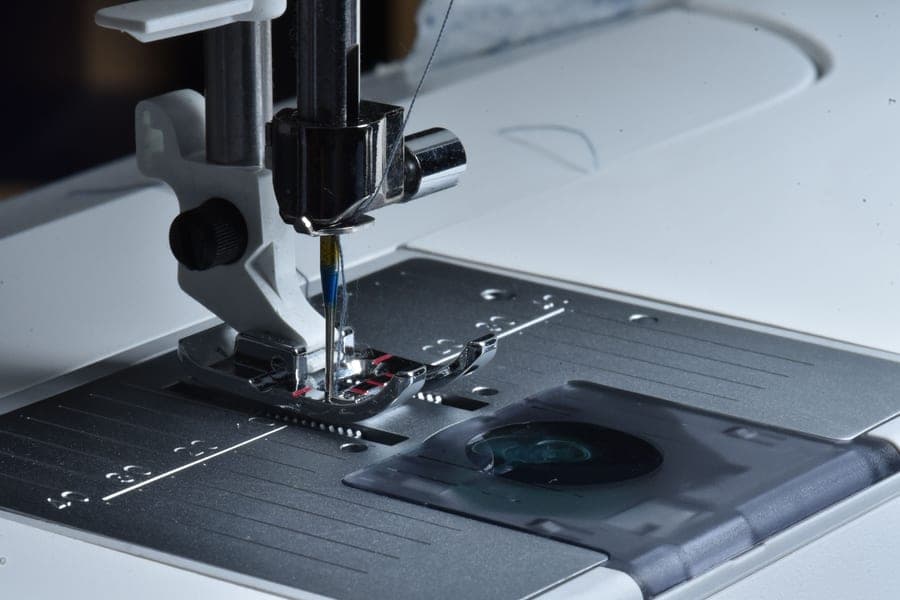
The one step beginners miss is the first. If the feed dogs are still pulling, the button travels and the needle hits it. You either lower the feed dogs with the drop-feed control, or cover them with the button-sewing plate that came in the accessory box, or - on machines with neither - set the stitch length to zero, which is usually enough.
The method, step by step
1. Mark the position. Button up the garment, push a pin through the buttonhole, and mark where it lands. Buttons sewn by eye end up a few millimetres out and the garment pulls.
2. Stop the feed. Lower the feed dogs if your machine has a drop-feed control, or fit the button plate, or set the stitch length to zero.
3. Fit the button foot if you have one. It is a short clear or open foot with a rubber grip that holds the button still. Without one, a standard zigzag foot works if you hold the button firmly.
4. Select zigzag and set the width by hand. This is the critical setting. Place the button, lower the needle into the left hole using the hand wheel, then turn the hand wheel through one full stitch and check by eye that the needle drops into the right hole. Adjust the width until it does. Never run the motor until you have checked this with the wheel - that is how needles break.
5. Sew six to eight stitches at a slow speed. Then set the width to zero and sew three or four stitches in one hole to lock the thread, or pull the threads to the back and knot them.
The button-sew stitch, if your machine has one
Many computerized machines include a dedicated button-sewing stitch. Select it and the machine sews the right number of zigzag stitches and stops on its own. It is the same operation with the counting done for you, and it still needs the width checked against your particular button.
The Brother CS7000X has one. Mechanical machines generally do not, which costs you nothing but attention. Our mechanical vs computerized guide covers which conveniences are worth paying for.
Which buttons a machine can handle, and which to sew by hand.
The one thing hand sewing still does better
A machine sews a button flat against the fabric. That is right for a shirt, where the fabric is thin. It is wrong for a coat, because the buttonhole side needs room to sit underneath - and if the button is flat against the cloth, the coat puckers when you fasten it.
The fix by hand is a thread shank: you sew over a toothpick or matchstick laid across the top of the button, remove it at the end, and the slack thread becomes a little stalk. You can do a crude version on a machine by sewing over a toothpick in the same way, but on a thick coat button hand sewing is faster and better. That is not a limitation worth worrying about - it is one button, twice a year.
Buttons and buttonholes are different jobs
Worth separating, because they get searched for together. Sewing a button on is the easy one. Sewing the buttonhole - the reinforced slit it passes through - is the job where machines genuinely differ, and it is the feature most worth paying for on a first machine.
A one-step buttonhole sews all four sides in one pass to the length of the button you dropped in the foot. A four-step buttonhole asks you to sew each side separately, turning a dial between them and judging the length yourself. Our buttonhole guide covers both properly.
Machines that handle buttons and buttonholes well
Chosen on the drop feed, the button-sew stitch and the buttonhole mechanism.
Brother CS7000X
A button-sew stitch, seven one-step buttonhole styles and a speed slider for control.
Skip it if You want physical dials instead of a menu, or you will be sewing canvas, upholstery or leather regularly.
Janome 2212
A genuine drop feed, so the fabric truly stops moving under the button.
Skip it if You want an automatic threader, a one-step buttonhole or a drop-in bobbin - it has none of them.
Brother XM2701
Adjustable-width zigzag and a one-step buttonhole at the cheap end of the range.
Skip it if You already know you will sew every week, or you want speed control and a quilting table.
#ad - buy links go to Amazon and earn us a commission at no extra cost to you. Full disclosure.
The picks in full
01 - Easiest for buttons
Brother CS7000X
Does the fiddly parts for you so you can spend your energy learning to sew.
- 70 built-in stitches, 7 one-step buttonholes
- Automatic needle threader, drop-in top bobbin
- Speed-control slider
- Wide table and 10 presser feet included
- Get it if
- You want threading, buttonholes and stitch settings handled by the machine, and you might try quilting later - the wide table is already in the box.
- Skip it if
- You want physical dials instead of a menu, or you will be sewing canvas, upholstery or leather regularly.
The trade-off
Light and mostly plastic. That makes it easy to carry and quiet on cottons and mid-weights; it is not built for heavy layers every day.
#ad - opens Amazon in a new tab. How we earn
How the Brother CS7000X scores
Our judgment on the six axes described on the methodology page. Not measurements - we do not run a test lab.
- Setup and threading
- 9/10
- Everyday stitch quality
- 8/10
- Thick fabric
- 6/10
- Beginner features
- 9/10
- Durability reputation
- 7/10
- Help for this exact model
- 10/10
Overall 8.2/10
02 - Best mechanical for buttons
Janome 2212
Twelve stitches, nothing to break - the classroom favorite.
- 12 stitches, dial controls, four-step buttonhole
- Drop feed for free-motion quilting
- Free arm for cuffs and sleeves
- A reputation for lasting decades
- Get it if
- You value reliability over conveniences and want a machine still working long after the computerized ones are gone.
- Skip it if
- You want an automatic threader, a one-step buttonhole or a drop-in bobbin - it has none of them.
The trade-off
Fewer conveniences, more longevity. The four-step buttonhole and front-loading bobbin are a little more work to learn.
#ad - opens Amazon in a new tab. How we earn
How the Janome 2212 scores
Our judgment on the six axes described on the methodology page. Not measurements - we do not run a test lab.
- Setup and threading
- 6/10
- Everyday stitch quality
- 9/10
- Thick fabric
- 7/10
- Beginner features
- 4/10
- Durability reputation
- 10/10
- Help for this exact model
- 7/10
Overall 7.6/10
03 - Cheapest that does it properly
Brother XM2701
The find-out-if-I-actually-like-this machine.
- 27 stitches, one-step buttonhole
- Automatic needle threader, drop-in bobbin
- 6 presser feet included
- Light enough to carry to a class
- Get it if
- You are not sure sewing will stick and you want a real, capable machine without spending what a better one costs.
- Skip it if
- You already know you will sew every week, or you want speed control and a quilting table.
The trade-off
Lightweight and basic. It does everything a beginner needs - buttonholes, zippers, hems - but you will outgrow it sooner than the CS7000X.
#ad - opens Amazon in a new tab. How we earn
How the Brother XM2701 scores
Our judgment on the six axes described on the methodology page. Not measurements - we do not run a test lab.
- Setup and threading
- 9/10
- Everyday stitch quality
- 7/10
- Thick fabric
- 5/10
- Beginner features
- 7/10
- Durability reputation
- 6/10
- Help for this exact model
- 9/10
Overall 7.3/10
Questions beginners actually ask
Can a sewing machine sew on buttons?
Yes. Almost any machine with a zigzag stitch can sew a flat two-hole or four-hole button. You stop the fabric feeding - with the drop-feed control, the button plate or a stitch length of zero - then set the zigzag width to match the gap between the holes.
What stitch do you use to sew on a button?
A zigzag, with the width set so the needle drops exactly into each hole, and the stitch length at zero so the fabric does not feed. Some computerized machines have a dedicated button-sewing stitch that counts the stitches and stops on its own.
Do I need a button foot?
It helps and it is not essential. A button foot has a rubber grip that holds the button still while the needle swings. Without one, a standard zigzag foot works as long as you hold the button firmly and sew slowly.
Which buttons cannot be sewn on by machine?
Shank buttons, because there is no hole for the needle to pass through; snap fasteners; decorative beads; and thick coat buttons, which need a thread shank so the fabric can sit underneath when fastened. Those are hand-sewing jobs.
How do I stop the needle hitting the button?
Turn the hand wheel by hand through one complete stitch before you touch the pedal, and watch the needle drop into each hole. Adjust the zigzag width until it clears both. A needle striking a button at speed can shatter and throw the machine's timing out.
Can a sewing machine sew buttonholes too?
Yes, and that is where machines genuinely differ. A one-step buttonhole sews all four sides in one pass to the size of the button you put in the foot. A four-step buttonhole sews each side separately with a dial turn between them and your own judgement of the length.
Sources
Specifications are taken from manufacturer listings. We do not run a test lab and never claim to - how each machine is assessed is set out on our methodology page.